Many of this work was exhibited at Lytham Heritage Centre in a joint exhibition, which ran from late March to the 8th of April.

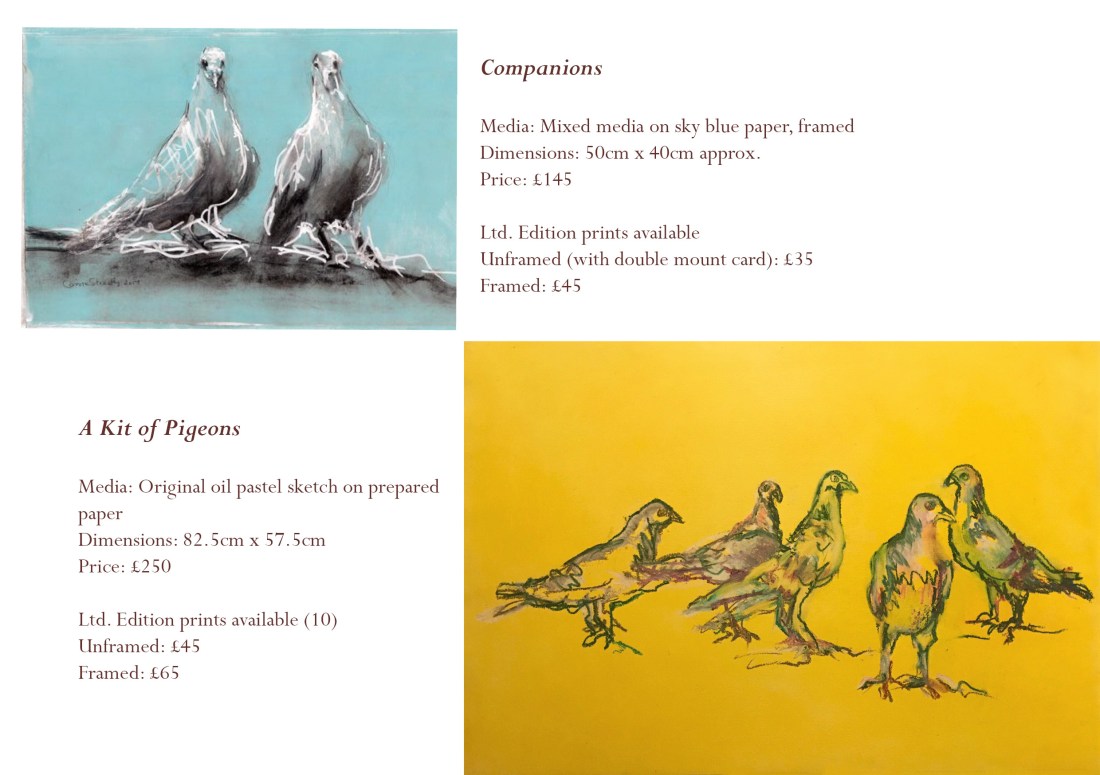
Pigeons: People either like them or they don’t. Some think they are vermin and call them flying rats. They’re a bit like Marmite, love them or hate them. I notice pigeons more now; it’s the bird most familiar in my immediate current location, along with seagulls. I vividly remember the thrill of feeding them corn in Trafalgar Square as a child, one of many highlights of visiting London. They’re seen everywhere, particularly outside local café’s in the town centre, vying with seagulls for food, and they nest above the window where I work, I hear them coo-ing.
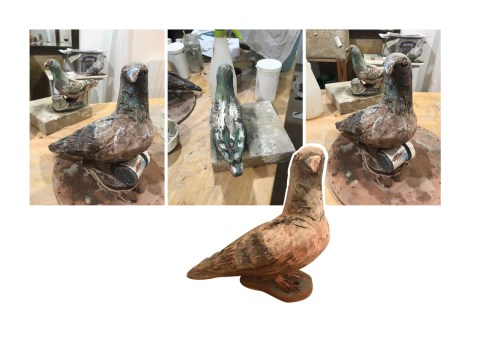 A work in progress of ‘Glazed ceramic pigeon’ (as seen below)
There are different sorts of pigeons; some are rather courageous and noble. During the 2nd World War, racing pigeons were often presented medals for their bravery. Every January for 47 years the British Royal Pigeon Association’s convention comes to Blackpool and the Winter Gardens complex and town centre is filled with pigeon fanciers coming together from all over the world.
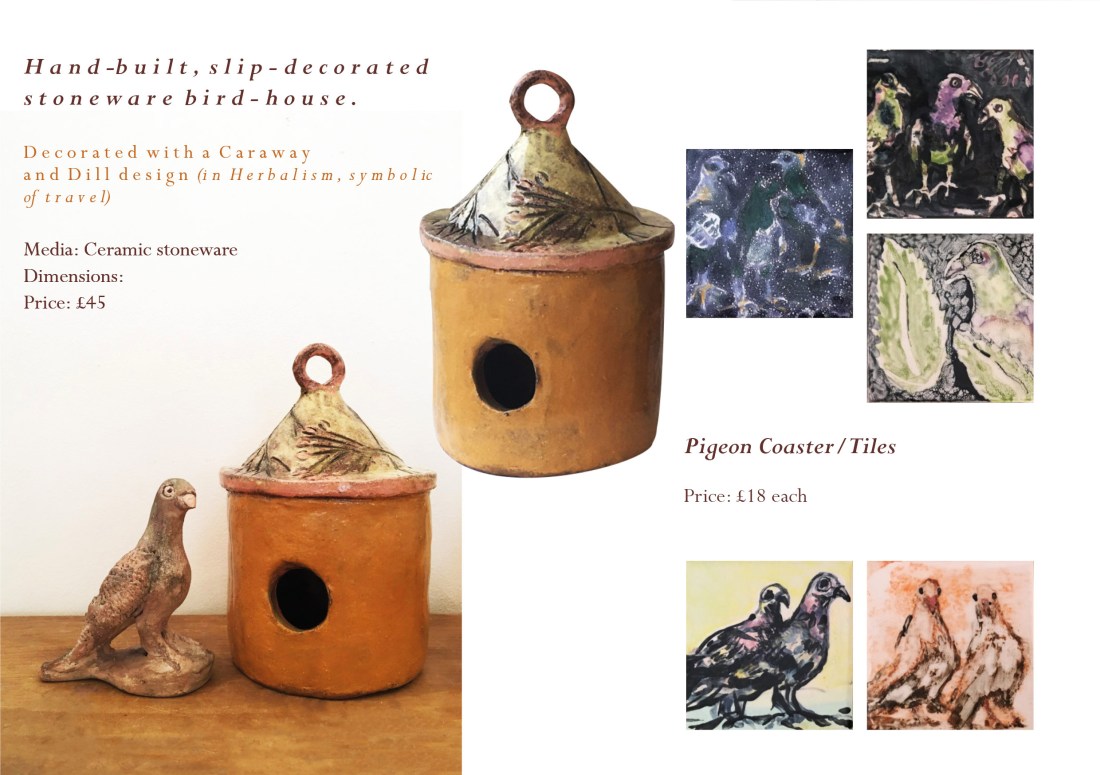
It’s a bit of a joke for the locals, but it’s a fascinating pursuit and the inspiration for most of my recent ceramics. I’ve referenced symbolic motifs on certain works, i.e. The birdhouse, which is decorated with seeds and herbs traditionally symbolic of travel in Herbalism, such as Dill, and nettle and basil, associated with courage.
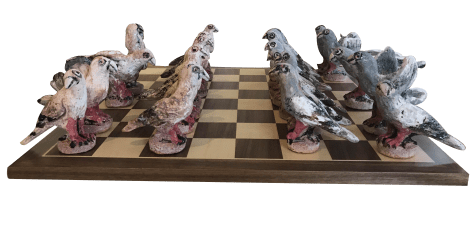 Pigeon chess set (work in progress, final board not yet complete)
Pigeon racing is based on the bird’s acute homing instinct. Each Friday evening, thousands of birds are taken by Lorry to distant parts of the country and released to find their way home, typically at speeds of 45 miles to 60 mph. The bird with the fastest overall speed is declared the winner. Britain’s 42,000 pigeon enthusiasts include the Queen, it’s one of her favourite hobbies, and her Sandringham estate in Norfolk has 170 birds.
There is the annual Blackpool Pigeon fancier’s convention, where many thousands of Britain’s 42,000 pigeon enthusiasts converge.
Also one of the Queen’s favourite hobbies, pigeon racing is based on the bird’s acute homing instinct. Each Friday evening, thousands of birds are taken by Lorry to distant parts of the country and released to find their way home, typically at speeds of 45 miles to 60 mph. The bird with the fastest overall speed is declared the winner.
During the 2nd World War, racing pigeons were sometimes presented/given medals for their bravery. I have included symbolic motifs on a few items, i.e. the birdhouse, which is decorated with seeds and herbs symbolic of travel in herb history. Dill is symbolic of travel, nettle with courage- so too, Basil.


Unfortunately, the sport could be extinct within a decade, thanks to Britain’s booming Hawk population. The Royal Pigeon Racing Association has issued a warning after reports that tens of thousands of its member’s birds were being eaten each year, mainly by Peregrine Falcons. The RSPCA estimating that half the racing pigeons are being lost each year. The key problem is with the surging number of urban falcons, encouraged by nesting boxes placed on church towers. “Peregrines are now deliberately nesting on pigeon racing routes.
Yet the sport of pigeon racing could be extinct within a decade thanks to Britain’s booming Hawk population. The Royal pigeon racing Association has issued a warning after reports that tens of thousands of its members birds were being eaten each year, mainly by Peregrine Falcons, who are deliberately nesting on pigeon racing routes, encouraged by nesting boxes placed on church towers. The RSPCA estimate that half the racing pigeons are being lost each year.
–

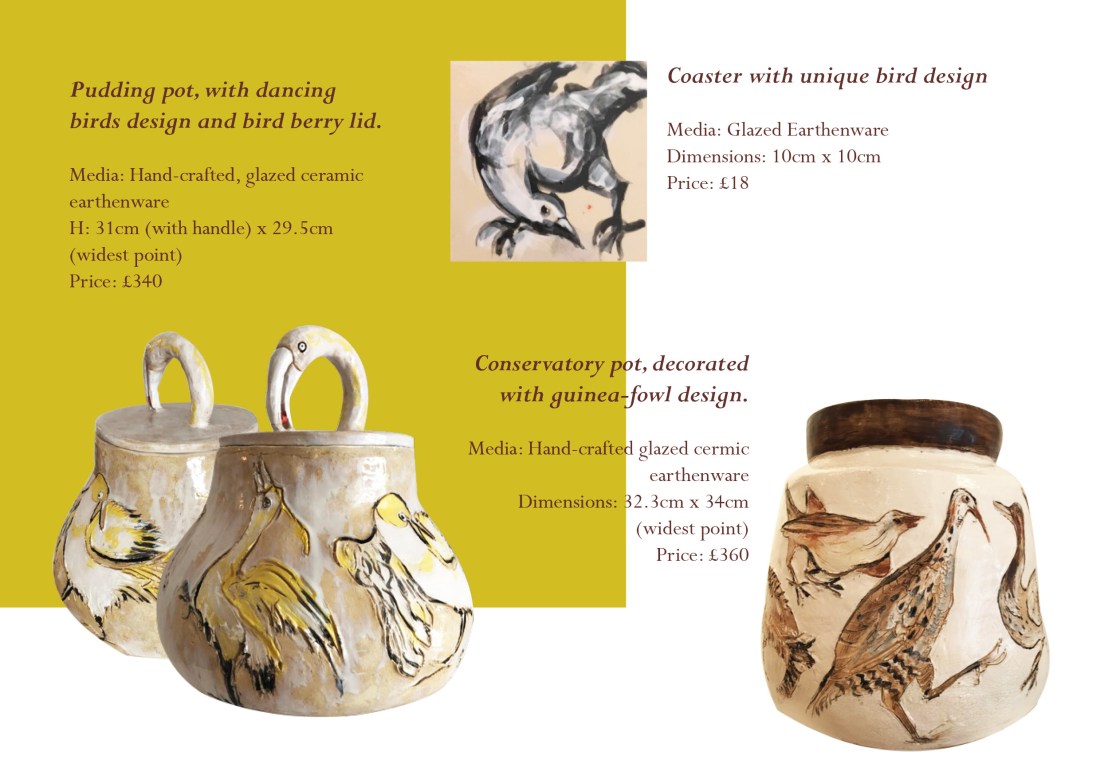
fowl design inspired by a pattern book in Samuel Pepys’ library, Cambridge.


–
 Corrine Streetly MA